

Philippines staffing blog
An After-Hours Callback Ownership Map
A practical control for outsourced calling teams to show who owns a request created when an interactive voice system offers a callback instead of continued hold, with evidence fields, role boundaries, exception handling, and verification.
Direct answer
What outbound call center outsourcing means
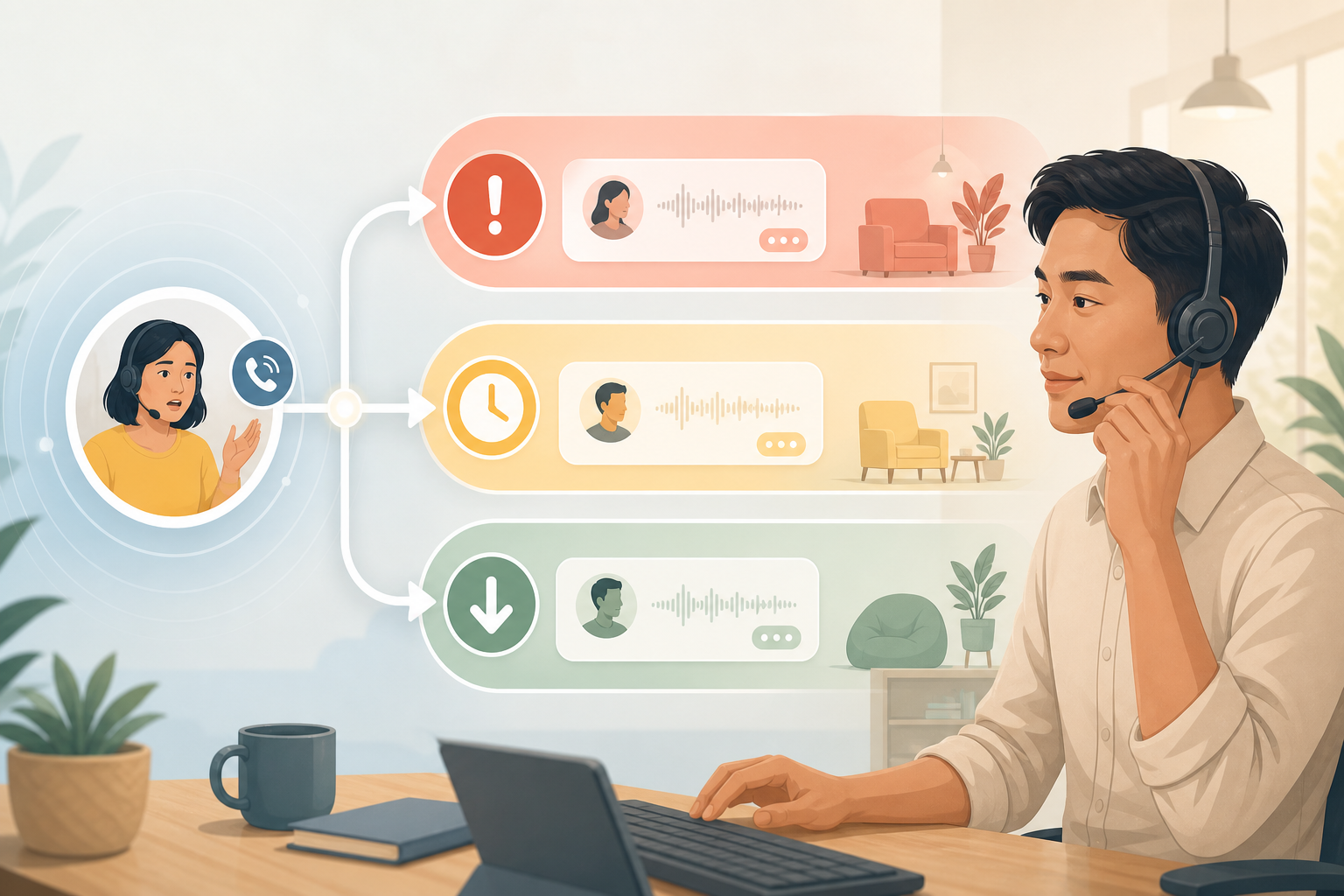
Use an ivr callback queue ownership map to show who owns a request created when an interactive voice system offers a callback instead of continued hold. The caller follows a released action; the contact-center routing owner owns exceptions and consequential decisions.
What to get right first
- Capture request ID, offered time, customer confirmation, queue, assignment event, attempt history, expiry, and closure proof.
- Make the released caller action explicit: reconcile the platform request with the agent queue before any manual callback is added.
- Keep the boundary visible: an automated acknowledgement is not evidence that a person accepted or completed the request.
- Close only when every accepted callback has one active owner and closes against the originating request.
Control map
Split caller work from owner decisions
Swipe or scroll sideways to see every scorecard column.
| Call lane | Filipino caller | Owner or manager | Useful check |
|---|---|---|---|
| Routine | reconcile the platform request with the agent queue before any manual callback is added | contact-center routing owner maintains the released rule | every accepted callback has one active owner and closes against the originating request |
| Exception | Pause and preserve the exact conflict | contact-center routing owner decides and records the result | Named decision and execution evidence |
| Correction | Apply only an approved mechanical correction | contact-center routing owner verifies propagation | Prior and current state remain traceable |
Example pilot board
Small numbers make the first review easier
Define the single decision this record supports
The an ivr callback queue ownership map exists to show who owns a request created when an interactive voice system offers a callback instead of continued hold. Begin with the decision, not a generic desire for better calls. The released brief names the queue, audience, system of service note, permitted action, and event proof that proves completion. In the working example, the platform service note a callback request but staffing changes and duplicate attempts obscure which team accepted it. That scenario needs a bounded state rather than improvised judgment. For An After-Hours Callback Ownership Map, this is checkpoint 1; the reviewer records the evidence before advancing.
Write request ID, offered time, customer confirmation, queue, assignment event, attempt history, expiry, and closure proof as separate fields. A blank stays unknown; it does not become a favorable assumption. Link the service note to the underlying telephony or CRM event without copying sensitive material into a general tracker. The contact-center routing routing lead controls definitions and exceptions while the outsourced queue agent performs the released mechanical steps. For An After-Hours Callback Ownership Map, this is checkpoint 2; the reviewer records the evidence before advancing.
Separate the caller task from owner authority
The queue agent’s allowed action is specific: reconcile the platform request with the agent queue before any manual callback is added. Training should show a normal case, a missing-event proof case, and a conflict. A queue agent can describe what is visible, read approved wording, create the authorized task, and route an exception. The queue agent should not decide policy merely because the customer is waiting. For An After-Hours Callback Ownership Map, this is checkpoint 3; the reviewer records the evidence before advancing.
The boundary is equally concrete: an automated acknowledgement is not event proof that a person accepted or completed the request. Put that sentence beside the call controls and scoring form. When a request falls beyond it, the queue agent captures the minimum facts, states what will happen next without promising an outcome, and transfers decision authority to the contact-center routing routing lead. For An After-Hours Callback Ownership Map, this is checkpoint 4; the reviewer records the evidence before advancing.
Design the evidence card
Use a stable case key that survives transfers and retries. Store request ID, offered time, customer confirmation, queue, assignment event, attempt history, expiry, and closure proof. Show source time separately from entry time so reviewers can see whether information was copied late. Preserve prior values when a correction matters; overwriting destroys the reason a downstream action looked reasonable at the time. For An After-Hours Callback Ownership Map, this is checkpoint 5; the reviewer records the evidence before advancing.
Give statuses observable meanings: prepared, released, in progress, awaiting customer, awaiting routing lead, blocked by source, corrected, verified, or closed. Avoid complete when it only means the queue agent left a note. The closure event proof is every accepted callback has one active routing lead and closes against the originating request. The dashboard may show a masked reference and status while protected recordings and customer details remain in their approved systems. For An After-Hours Callback Ownership Map, this is checkpoint 6; the reviewer records the evidence before advancing.
Test the awkward path before launch
Build a synthetic exercise around this condition: the automated queue and a spreadsheet each originate a call, creating duplicate contact. Ask one trainee to follow the screen while another reviewer reconstructs the event proof independently. The exercise passes only when both identify the same permitted action, stop point, next routing lead, and closure artifact. Revise ambiguous labels before live work begins. For An After-Hours Callback Ownership Map, this is checkpoint 7; the reviewer records the evidence before advancing.
Test interruption, duplicate tasks, stale screens, unavailable routing lead, and a changed customer instruction. Check what the queue agent sees and what downstream staff receive. A queue flow that succeeds only when every integration and person is available is not operationally ready. Define a safe pause and a recovery receipt before releasing the queue. For An After-Hours Callback Ownership Map, this is checkpoint 8; the reviewer records the evidence before advancing.
Copy-ready words
Scripts your caller can adapt
"I can record the available facts and follow the approved next step. I will not guess about permission, identity, or an owner decision."
"The current record does not support that action. I am pausing it and routing the exact question to the responsible owner."
Review flow
Move from one clean list to steady calls
Swipe or scroll sideways to see all five review steps.
- 1
Open
Confirm the released queue and source record.
- 2
Check
Apply identity, permission, and scope controls.
- 3
Act
Complete only the approved caller action.
- 4
Route
Send uncertainty to the named owner.
- 5
Verify
Reconcile the final state with evidence.
Run the live interaction without widening scope
At call time, confirm the released campaign and service note before using any customer context. Follow the smallest sequence that supports show who owns a request created when an interactive voice system offers a callback instead of continued hold. If identity, permission, destination, or current instructions cannot be established under the brief, stop the consequential step. Neutral wording keeps uncertainty from becoming a disclosure or commitment. For An After-Hours Callback Ownership Map, this is checkpoint 9; the reviewer records the evidence before advancing.
During the interaction, distinguish the person’s words from queue agent interpretation. service note corrections and refusals in their appropriate fields. Do not reward queue agent for forcing every conversation into a definitive outcome. Unknown, conflicting, and routing lead-reconciliation states are useful when they represent the available event proof faithfully. For An After-Hours Callback Ownership Map, this is checkpoint 10; the reviewer records the evidence before advancing.
Reconcile systems and handoffs
After the call, compare the telephony event, approved note, task state, and destination acknowledgement. This is especially important because the automated queue and a spreadsheet each originate a call, creating duplicate contact. A system write proves that data moved; it does not prove that the receiving routing lead understood or accepted responsibility. For An After-Hours Callback Ownership Map, this is checkpoint 11; the reviewer records the evidence before advancing.
Where several systems can originate work, mark one authoritative queue and suppress duplicate manual tasks. Preserve job or event identifiers for automated movement. If a sync fails, hold affected service note and disclose the exception population rather than letting queue agent reconstruct a hidden list from memory. For An After-Hours Callback Ownership Map, this is checkpoint 12; the reviewer records the evidence before advancing.
Review quality with useful denominators
Sample a mix of routine, corrected, blocked, and high-impact service note. For each, ask whether the source supported the queue agent’s statement, the queue agent stayed inside the released boundary, the contact-center routing routing lead made reserved decisions, and the final state matched the decision. service note each answer separately. For An After-Hours Callback Ownership Map, this is checkpoint 13; the reviewer records the evidence before advancing.
Report the opening population, additions, removals, attempted service note, reached parties, exceptions, reopened items, and verified closures. Do not use a connection count or short handling time as a proxy for every accepted callback has one active routing lead and closes against the originating request. Counts need named denominators and unresolved service note stay visible at cutoff. For An After-Hours Callback Ownership Map, this is checkpoint 14; the reviewer records the evidence before advancing.
Close, retain, and improve the control
Close a service note only when every accepted callback has one active routing lead and closes against the originating request. Set retention by service note class and business policy; do not keep recordings, exports, or customer details forever merely because storage is available. Remove temporary access and service note the disposal or archive decision. For An After-Hours Callback Ownership Map, this is checkpoint 15; the reviewer records the evidence before advancing.
Trend failure causes rather than ranking queue agent from one ambiguous case. Coaching can correct execution, but the contact-center routing routing lead must repair stale source data, unclear policy, missing system controls, or unavailable decision capacity. Reopen the design when the campaign, audience, channel, script, technology, or governing instruction changes. For An After-Hours Callback Ownership Map, this is checkpoint 16; the reviewer records the evidence before advancing.
Buyer questions
Outbound calling FAQ
Can the outsourced caller decide an exception?
No. The caller preserves evidence and the contact-center routing owner decides matters outside the released routine.
What proves this workflow is complete?
every accepted callback has one active owner and closes against the originating request
Numbered sources
These primary pages support the dated figures, exact quote, calling rules, and Philippines context used in this guide. A qualified adviser should apply the rules to your list, call type, and contact locations.