

Philippines staffing research
How should buyers sample deviations from an outsourced calling script?
A risk-based method for distinguishing harmless wording variation from changed claims, missing disclosures, unsupported promises, and broken stop rules.
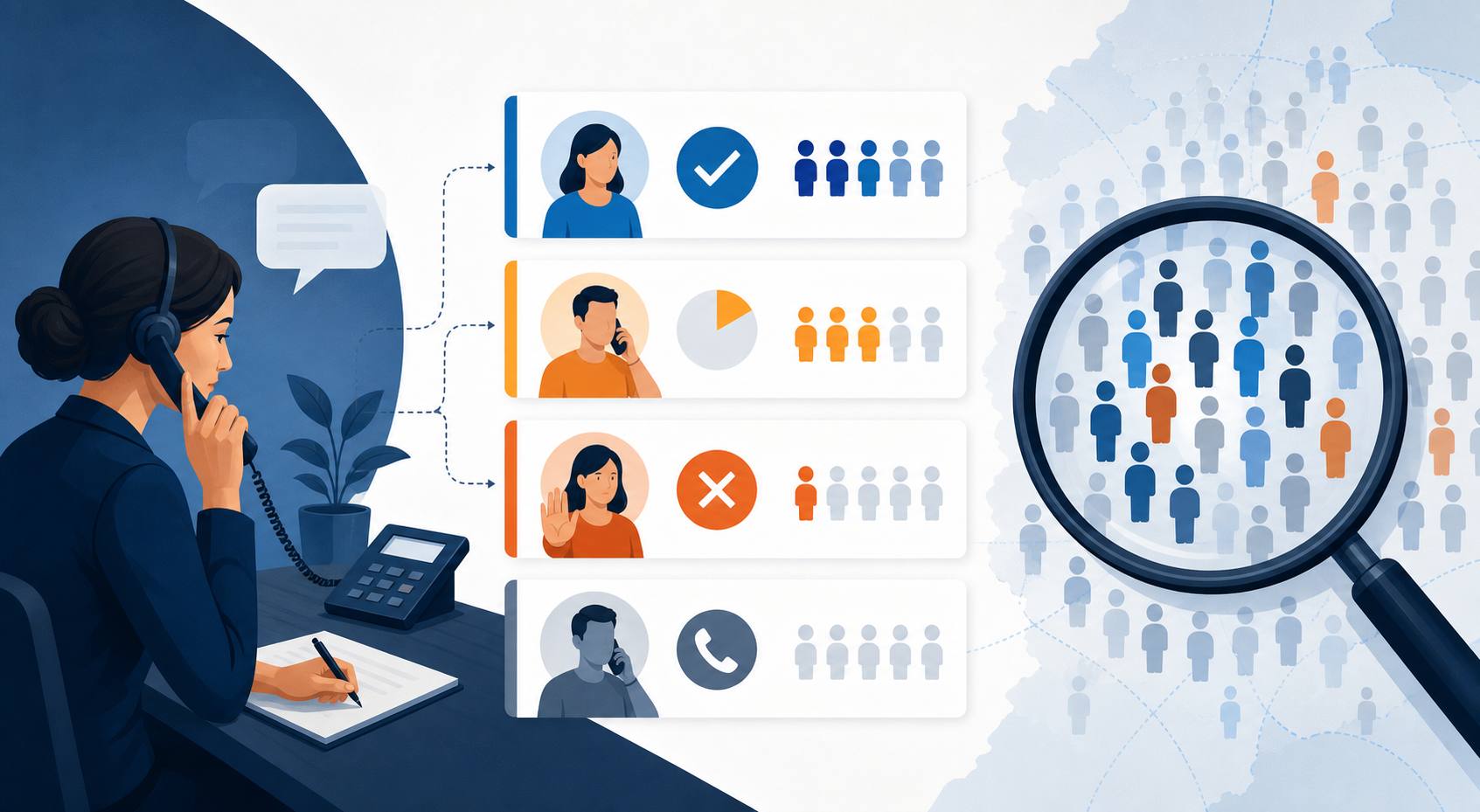
Research question and evidence scope
Research question: How should buyers sample deviations from an outsourced calling script? A risk-based method for distinguishing harmless wording variation from changed claims, missing disclosures, unsupported promises, and broken stop rules. The design evaluates one bounded evidence workflow for Philippines-based callers. It distinguishes observable call events from client decisions and reports no company performance.
Define the script elements by function: mandatory disclosure, identity step, purpose statement, approved questions, prohibited claim, price or policy language, stop handling, escalation trigger, and closing promise. Not every sentence needs verbatim delivery, but every protected function needs an observable criterion. Publish the population definition, inclusion rules, observation window, time zone, systems, roles, and unavailable evidence before inspecting results. Reconcile opening records, additions, removals, transfers, and ending records. A later reader should be able to reproduce which cases counted without accepting a denominator chosen after the outcomes were known.
Create deviation classes before listening: equivalent paraphrase, omitted required element, added unsupported claim, changed meaning, early disclosure, leading question, inaccurate readback, unapproved commitment, failed stop, or necessary exception routing. Include an uncertain category for poor audio or missing context. Keep source fact, caller preparation, client decision, and verified outcome in separate fields. Telephony logs can show an event without explaining purpose or authorization; CRM notes can describe a statement without proving the final system state. The analysis should identify which artifact supports each claim and label unknown rather than filling gaps from context.
Operating scenario and evidence
Build a sample using random calls plus all high-risk outcomes, new campaigns, new callers, changed scripts, complaints, conversions with unusual promises, payment or health topics, wrong-party events, and owner escalations. A convenience sample of short clean calls will understate risk. Use named accounts, least privilege, controlled exports, and a retention rule appropriate to recordings, transcripts, contact data, and reviewer notes. Pseudonymous case keys can support comparison without creating a second operational database. Remove temporary access when the study closes and record any system that could not be examined safely.
Blind reviewers to caller performance scores and commercial outcome during first assessment. Knowing that a sale closed or a complaint occurred can bias interpretation of ambiguous wording. Reveal downstream evidence only during the consequence review. Include every defined high-risk case and add a small random sample. Risk selection detects expected failure modes while random selection can reveal routine defects outside the model. Preserve substitutions and unavailable records. Excluding inconvenient cases because audio is poor or the outcome is unresolved creates an artificially clean estimate.
Method and review criteria
Compare transcript, audio, screen prompts, script version, customer response, caller note, disposition, and downstream action. Automated transcripts can omit negation, names, accents, overlapping speech, or numbers and should not replace audio review when the distinction is material and lawful. Have reviewers assess selected records independently before discussing them. Preserve disagreement by category, then examine the source, instruction, interface, and downstream effect. Agreement can be quantified, but one high-impact conflict should not disappear inside an average dominated by straightforward records.
Rate consequence separately from frequency. A single credential request, consent failure, discriminatory statement, false price promise, or unsafe instruction may require urgent remediation even if hundreds of routine paraphrases were acceptable. Report counts, values where relevant, medians, ranges, age bands, and denominators. Separate leading process indicators from customer or business outcomes. A quick call, connected party, completed form, or clean disposition may still lack permission, correct identity, owner action, or verified closure.
Calibrate reviewers on edge cases and measure agreement. When reviewers disagree repeatedly, revise the rule, example library, interface, or owner boundary rather than averaging the scores and treating ambiguity as caller inconsistency. Test sensitivity to reasonable cutoff, risk band, missing-evidence, and unresolved-case assumptions. Identify conclusions that persist and those that depend on policy choices. The purpose is not to select the most favorable result, but to show which interpretation requires accountable client judgment.
Authority and practical implications
Link corrective action to cause. Coaching may address delivery; stale scripts require content ownership; hidden prompts require product change; impossible disclosures require routing redesign; commercial incentives may require management intervention. Verify the fix with a new sample. Maintain a corrective-action record with condition, evidence, owner, due date, implementation reference, verification, and residual limitation. Closing a meeting or coaching session is not the same as changing the operating state. Re-sample after script, system, list, integration, or owner changes.
Report sample frame, exclusions, script versions, reviewed minutes, deviation counts by type and severity, reviewer agreement, unresolved evidence, and limits. The estimate describes the examined population and cannot prove that unrecorded or unsampled calls complied. State limitations prominently. Call records can be incomplete, customer statements can conflict, shared numbers complicate linkage, and recorded populations may differ from unrecorded work. The study reports no OutsourcedCallers.com performance and does not establish consent, compliance, identity, safety, financial accuracy, or legal conclusions.
The final review should pair the deviation taxonomy with representative excerpts, script version, customer response, business consequence, and corrective action. Publish both harmless paraphrases and serious exceptions so readers can see that deviation count alone is not a risk measure. Recheck a fresh sample after remediation and keep unresolved evidence visible. Buyers should use the study to improve script functions, tools, coaching, and incentives, while qualified owners retain legal and policy decisions about disclosures, claims, permission, safety, and protected customer interactions.
Limitations, conclusion, and sources
A governance review should then ask four separate questions: was the source evidence complete, did the caller stay inside the released role, did the correct owner make every reserved decision, and did the final system state match that decision? Record answers and limitations independently. Use the findings to change field definitions, scripts, routing, access, integrations, or owner capacity, then retest the affected path. Do not use an aggregate score to offset a serious unauthorized disclosure, contact, promise, credential request, safety error, or payment action. Preserve the dated method and source versions so later comparisons do not pretend the workflow stayed constant.
Implementation should begin with redacted or synthetic cases, proceed to shadow preparation reviewed in full, and enter limited production with an explicit rollback. The client should name the person who can pause the lane, the systems that must be reconciled, the incident route, and the evidence retained at each gate. Monitor new exception types rather than assuming the pilot represented every future call. Reopen the design when campaign purpose, source list, technology, jurisdiction, language, customer population, script, provider, or decision owner changes. This research supports a more testable handoff; it does not replace professional advice, customer-specific review, or ongoing supervision.
For buyer review, retain a concise evidence packet containing the frozen question, source inventory, population receipt, codebook, sampled case keys, independent assessments, exception log, owner decisions, corrective actions, and unresolved limitations. Keep the operational records in their approved restricted systems and use controlled references in the report. A later reviewer should be able to reproduce the analysis without receiving a bulk copy of customer data. If that cannot be done, document why and narrow the claim rather than treating unavailable evidence as a successful check.
Sources checked October 8, 2026: Federal Trade Commission | https://www.ftc.gov/business-guidance/resources/complying-telemarketing-sales-rule || Federal Communications Commission | https://www.fcc.gov/consumers/guides/stop-unwanted-robocalls-and-texts || NIST Privacy Framework | https://www.nist.gov/privacy-framework || U.S. Government Accountability Office | https://www.gao.gov/products/gao-25-107721