

Philippines staffing research
How should inbound teams handle a callback tied to the wrong account?
An inbound-call study for routing a legitimate callback request without confirming another customer’s relationship or exposing case details.
Research question and evidence scope
The study starts from an information asymmetry: the interface may confidently display a customer while the human caller knows only that they received or returned a call. A safe workflow must let the agent help without testing the displayed identity through revealing questions. This makes neutral language an operational control, not a courtesy. The evidence review should examine the words used before any approved match, because later verification cannot erase an earlier disclosure.
Methodology. Capture consecutive inbound callbacks that produce multiple account candidates, a failed candidate, or a caller dispute. Add a blinded audit sample of callbacks the system labeled as clean. Freeze codes for candidate source, neutral opening, identifiers requested, match result, disclosures, temporary restrictions, route, owner acknowledgement, correction action, and final resolution. Reviewers first assess the transcript up to the match decision, then reveal downstream records.
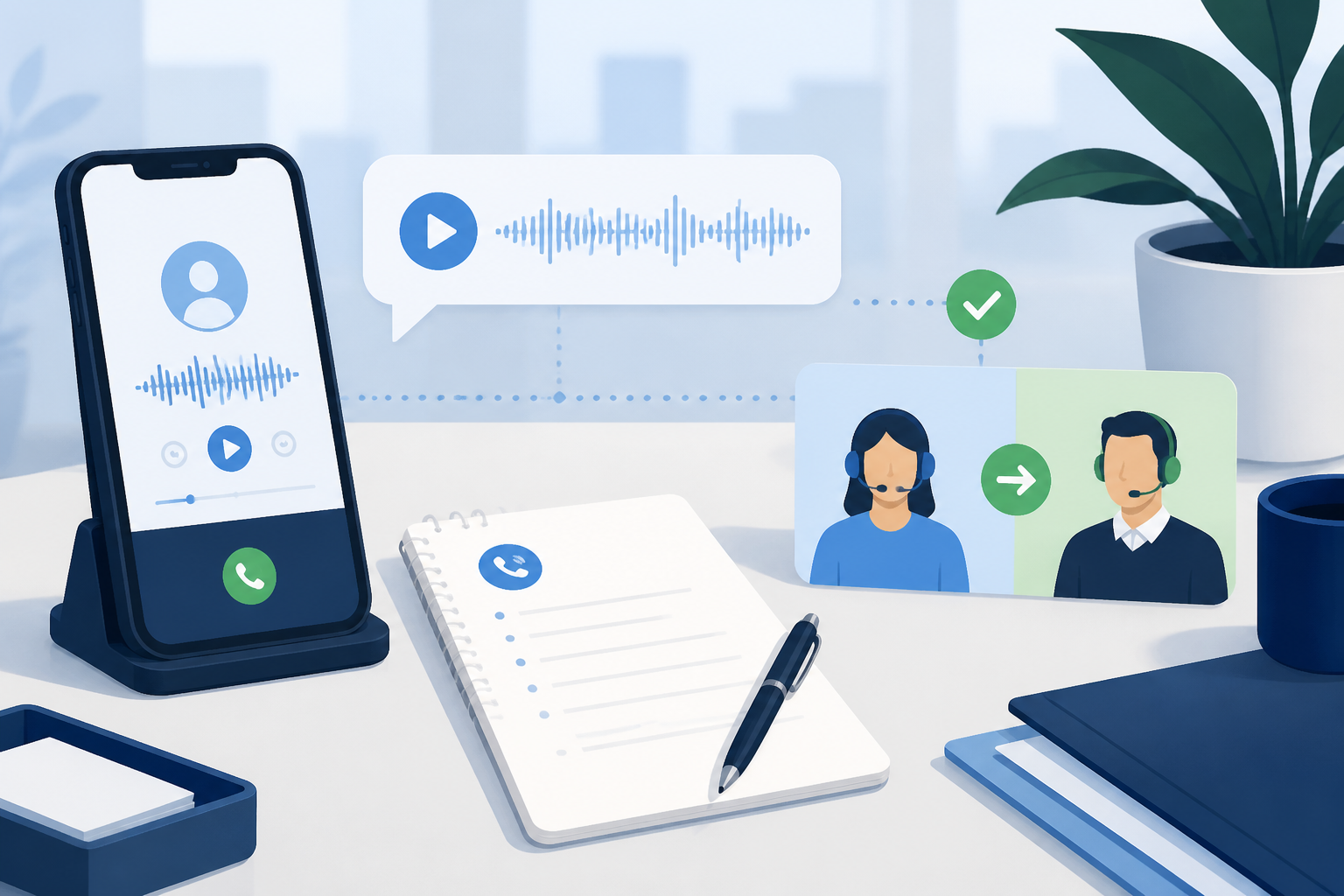
A conversation map should branch on purpose before account detail. The caller can identify the organization reached, ask for a non-sensitive reason, and offer an approved secure route. If the person supplies a reference, the agent checks it without reading back candidate information. A failed match leads to no-match intake or transfer, not increasingly specific hints. Emergency and accessibility paths should be separately released so neutrality does not become abandonment.
Operating scenario and evidence
Root-cause work happens after the safe interaction. Compare callback number fields, communication preferences, outbound attempt logs, duplicate contacts, forwarding rules, and corrections using pseudonymous identifiers. Keep hypotheses separate: a shared line is not reassignment; a duplicate record is not spoofing; an old callback field is not proof that the caller is unauthorized. Owners should record the evidence used when merging, separating, or restricting records.
Outcomes form two families. Interaction outcomes include unnecessary disclosure, safe-route completion, caller abandonment, and repeat contact. Data outcomes include candidate correction, duplicate resolution, source-lineage preservation, and later false match. Report them independently. A fast successful route may still disclose another person’s relationship, while a cautious unresolved route may protect privacy but reveal a process gap that needs owner attention.
Method and review criteria
Limitations and non-claims. Recordings can start late, caller ID can be missing or manipulated, and account owners may correct data beyond the review window. Neutral wording cannot guarantee that a caller infers nothing from context. The study cannot establish identity, intent, or legal compliance and makes no claim about OutsourcedCallers.com error rates. It evaluates whether a defined callback workflow contains mismatches safely.
Niche-specific conclusion. An inbound outsourced team needs a deliberately useful no-match state, not pressure to attach every call to a customer. Buyers should inspect neutral openings, minimum match fields, correction ownership, and preservation of the original link. Agents may capture purpose and route uncertainty; the client controls identity policy, account merges, disclosures, and durable correction.
Language testing should include indirect confirmation. Phrases such as “that account is closed,” “she is not listed here,” or “the ticket number belongs to someone else” reveal relationships even when the agent refuses details. Reviewers should compare these with neutral alternatives that acknowledge a mismatch without naming the candidate. Score whether the interaction still offers a practical path so privacy protection is not achieved by simply ending difficult calls.
Authority and practical implications
Correction quality requires provenance. When an owner changes a phone field or separates duplicate accounts, retain the source that supported the action, the previous link, the effective time, and any queue restrictions lifted or added. The caller’s mismatch report remains an observation, not authority for deletion. Later reviewers need to see whether the repair addressed the same identifier and prevented another incorrect callback.
Test service continuity after no-match intake. Measure whether a legitimate caller reaches an appropriate general queue, secure callback process, or named owner; whether the bounded purpose survives transfer; and whether the caller must repeat sensitive context. A neutral workflow that never resolves valid requests imposes a different harm. Report safe resolution and privacy failures together without treating either as a complete proxy for the other.
The final analysis should show candidate source, mismatch category, disclosure result, route, acknowledgement, correction, repeat contact, and unresolved state. Include the clean-match audit denominator to estimate interface blind spots. Avoid a leaderboard by agent unless exposure and system behavior are comparable; the central decision is whether workflow controls contain an uncertain match and create an accountable repair path.
Limitations, conclusion, and sources
A controlled pilot should seed synthetic duplicate and shared-number scenarios alongside ordinary calls, without placing real customer data in training records. Review whether agents use neutral language, choose the no-match state, preserve the stated purpose, and reach the correction owner. Repeat after interface changes because a new screen-pop or autocomplete feature can reintroduce confident but unsupported matching even when the written procedure has not changed.
Supervisors need a correction loop that does not punish safe uncertainty. Review a sample of no-match outcomes, identify whether better released sources could have resolved them, and repair interface or routing gaps before changing agent targets. If productivity measures reward attached accounts, agents may guess to avoid an unresolved code. The buyer should align metrics so correct containment and useful routing count as legitimate outcomes.
Document the customer-safe closure for each branch. A matched caller receives only the information and action permitted after the approved check. An unmatched caller receives a general route or secure callback option. A suspected data defect receives a reference that does not expose another account. Clear closure language reduces repeated explanation while keeping account repair and identity decisions with authorized owners.
Start with a neutral-response protocol. A displayed account, inbound number, reference string, or recent outbound attempt is a candidate link, not proof of identity or authority. The caller should ask only the approved minimum needed to find a safe route and avoid questions that reveal the candidate record. “Which organization were you trying to reach?” is different from naming the customer shown on screen. The study should code both direct disclosures and indirect confirmations created by phrasing.
Classify mismatch causes without forcing certainty: shared household or business line, recycled number, data-entry error, duplicate record, forwarded call, proxy contact, outdated callback field, spoofed caller ID, or unknown. The calling agent can preserve the observed conflict and apply a temporary routing state. Durable merge, deletion, identity, and account-ownership decisions belong to a data or account owner with access to authoritative sources and a correction trail.
Build the cohort from inbound callbacks that open multiple candidates or fail the expected match. Include resolved calls, safe transfers, abandoned contacts, unverifiable references, and corrections made later. Audit a sample of apparently clean matches for hidden duplicates so the observed mismatch rate does not merely describe what the interface flags. Keep the original link visible in the study copy as a pseudonymous event; otherwise later cleanup erases the condition being evaluated.
Report neutral-intake adherence, unnecessary disclosure, safe-route completion, owner acknowledgement, duplicate-link correction, repeated contact, unresolved callback, and false mismatch. Resolution time should pause only under a predeclared rule and should not hide time waiting for an authorized owner. A quick transfer can still be poor if it reveals the wrong relationship, while a bounded unresolved outcome can be appropriate when no secure match is available.
The practical control is a candidate-account warning, a neutral intake script, a minimum matching path, an explicit no-match state, temporary suppression where relevant, and a correction queue that preserves source lineage. Buyers should test shared numbers and duplicated identifiers before launch. Filipino inbound callers can collect a bounded purpose and route uncertainty; the client owns account matching, identity policy, correction approval, and disclosure permissions.
Sources: NIST Privacy Framework | National Institute of Standards and Technology | https://www.nist.gov/privacy-framework | checked 2026-10-02 || Protecting Personal Information: A Guide for Business | Federal Trade Commission | https://www.ftc.gov/business-guidance/resources/protecting-personal-information-guide-business | checked 2026-10-02 || Republic Act No. 10173: Data Privacy Act of 2012 | National Privacy Commission of the Philippines | https://privacy.gov.ph/data-privacy-act/ | checked 2026-10-02 || Records Management Regulations, Policy, and Guidance | National Archives and Records Administration | https://www.archives.gov/records-mgmt/policy | checked 2026-10-02 || Unwanted Calls, Texts, and Faxes | Federal Communications Commission | https://www.fcc.gov/general/unwanted-calls-texts-and-faxes | checked 2026-10-02