

Philippines staffing research
When can a partial telephone survey be continued later?
A protocol-integrity study for deciding whether an interrupted interview may resume without duplicating answers, changing respondent context, or weakening consent.
Research question and evidence scope
Research question and decision context. This study asks: When can a partial telephone survey be continued later? For a business evaluating Filipino callers for survey calling, the operational decision is whether the approved instrument permits a later continuation, requires a restart, records a partial completion, or must stop after refusal or withdrawn permission. The question is intentionally narrower than whether calls are productive. A decision-grade answer must preserve what the released record showed, what the contact actually said, what the approved workflow allowed, and what a named client owner later decided. Familiarity, confidence, a clean disposition, or a plausible interpretation is not a substitute for evidence.
Methodology. Use a prospective record review with definitions fixed before the observation window. Treat one interrupted interview, respondent and consent state, instrument version, completed item boundary, interruption reason, approved resume rule, later contact, final status, and analysis treatment as the observation unit. Define eligibility, required evidence, exclusions, outcome codes, time boundaries, and workflow versions before sampling. Give each unit a pseudonymous study identifier that links the release, contact, handoff, owner action, and final state without copying unrelated personal information into the analysis file. Record the study dates and every material rule change.
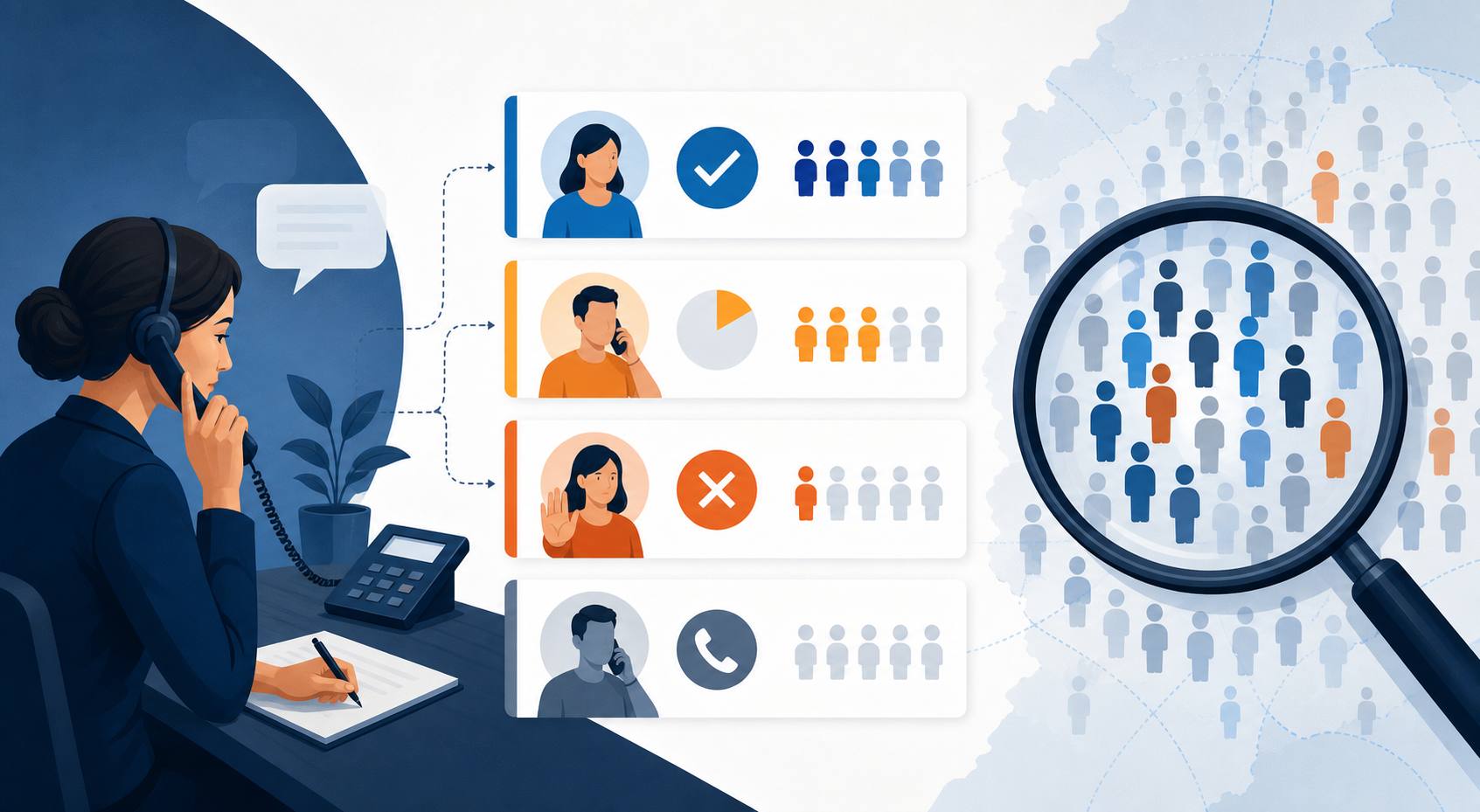
The study scenario should remain concrete: A respondent answers several questions and then must end the call. They say another time may work, but the instrument does not clearly state how long answers remain valid or whether a different interviewer may resume. Preserve the material source fields and the contact’s words separately from the caller’s classification. Then capture the smallest permitted caller action, any stop or escalation, the receiving owner, an observable receipt event, and the final authoritative state. Reviewers must be able to distinguish “the source displayed,” “the contact stated,” “the caller recorded,” and “the owner approved.”
Operating scenario and evidence
Primary outcomes. Score source fidelity, authority alignment, note completeness, routing accuracy, owner receipt, and final-state reconciliation separately. Source fidelity means a repeated fact traces to a named, dated source available at contact time. Authority alignment means the action stayed inside the released brief. A complete handoff names the material fact or request, the unresolved decision, the recipient, and the due or review condition. Receipt requires an observable acknowledgement or queue event, not an assumption that sending equals seeing.
Failure hypothesis. The principal risk is that a polite interruption is coded as consent to repeated calls, earlier answers are duplicated or silently changed, or a resumed interview crosses instrument versions and is analyzed as one consistent session. Test that explanation against alternatives: stale source data, an unclear client rule, a missing workflow state, inaccessible ownership, system synchronization, caller departure from the brief, or later changes outside the calling team. Code stages independently. A downstream mismatch should not automatically be attributed to the caller, and a correct final result should not excuse unsupported wording or an unauthorized intermediate action.
Method and review criteria
Sampling plan. Combine a consecutive baseline sample with an intentional exception sample. The baseline estimates how often evidence states appear in ordinary work; the exception sample supplies enough difficult cases to test the boundary. Report them separately so oversampling does not imply exceptions are typical. Include successful contacts, refusals, no-answer attempts followed by contact, corrections, transfers, unresolved records, and records changed after the call. Count exclusions and missing chains rather than silently dropping them.
Data collection. Capture only what answers the research question: released purpose, source name and timestamp, relevant status, workflow version, suppression or permission state, contact event, material statement, caller disposition, escalation route, owner receipt, owner action, and final record state. Use controlled codes plus a short evidence note. Do not copy full recordings, passwords, payment data, government identifiers, health details, or unrelated history into the research dataset. The survey research owner should approve access, retention, correction, and deletion rules.
Facts, analysis, inference, and uncertainty. A timestamped source field is a fact when its provenance is retained. Comparing that field with the final record is analysis. Claiming that a wording choice caused behavior is an inference unless the design tests causation. Missing audio, overwritten values, unavailable acknowledgements, conflicting clocks, and actions in an unobserved system create uncertainty. The report should label these categories and retain plausible competing explanations rather than forcing every unit into a confident story.
Authority and practical implications
Reviewer reliability. Create a codebook with positive examples, negative examples, and explicit cannot-determine rules. Two reviewers should independently code a blinded pilot containing routine and difficult units. Report agreement for each critical field, discuss disagreements, revise ambiguous definitions, and recode affected pilot units under the final guide. Adjudication may settle the study classification, but it must not rewrite the underlying source, caller note, or genuine conflict between records.
Analysis. Begin with counts and denominators: records released, attempts, contacts, qualifying scenarios, complete evidence chains, aligned actions, acknowledged handoffs, reconciled final states, exclusions, and unknowns. Show both counts and proportions where group size permits. Compare workflow versions only when populations and observation windows are reasonably similar. Keep completeness distinct from correctness: a fully populated record can document an unsupported action, while a sparse record may hide a correct action.
Bias and sensitivity. Queue age, campaign source, contact mix, caller schedule, language, owner staffing, system availability, policy changes, and missing evidence may affect results. Predefine these variables when practical. Separate records released before and after material workflow changes. Treat missingness as a finding because late notes or absent receipts may cluster in difficult cases. Recalculate conclusions with unknowns classified conservatively and report whether the operational decision changes.
Limitations, conclusion, and sources
Operational boundaries. A Filipino caller can follow a current brief, ask an approved clarification, preserve material words, honor a stop request, apply a permitted disposition, and route uncertainty to the named owner. The caller should not invent consent, location, authority, identity, eligibility, commercial terms, urgency, or final record status. The survey research owner retains policy, sensitive exceptions, and irreversible decisions unless a specific bounded action has been expressly released with an authoritative source.
Privacy and security. Apply minimization to both production work and the study copy. Use role-based access, named accounts, bounded exports, secure transfer, and a retention period tied to purpose. Preserve corrections without erasing the evidence trail. The NIST Privacy Framework provides a voluntary privacy-risk structure, FTC business guidance emphasizes limiting retained personal information and controlling access, and the Philippines Data Privacy Act is a relevant first-party statutory source. Qualified advisers must determine duties for the actual data, people, technology, and jurisdictions.
Implementation test. Translate one observed gap into the smallest prospective control: a required source timestamp, confidence field, distinct review state, named recipient, receipt acknowledgement, or structured reason for correction. Pilot one control with a defined sample and time window. Compare evidence completeness, boundary alignment, and unresolved-case visibility before wider adoption. Avoid changing scripts, queue rules, and review policy simultaneously because the study would not reveal which change mattered.
Limitations and non-claims. This protocol does not report OutsourcedCallers.com performance, promise a result, decide legal compliance, or establish causation from descriptive records. A sample can be small, selected, or affected by unobserved work. Source timestamps can disagree, recordings can be partial, and owners may act outside the reviewed system. Results apply to the studied workflow, population, versions, and period; they should not be generalized to every caller, campaign, customer, or jurisdiction.
Niche-specific conclusion. For survey calling, the useful evidence chain runs from the released source through the contact and caller action to owner receipt and the client-controlled final state. The standard is not that every record closes neatly. It is that permitted action is visible, uncertainty stops at the correct boundary, the survey research owner receives a usable decision packet, and later reviewers can reconcile the outcome without guessing. A buyer should inspect these fields, states, and ownership rules before relying on volume totals.
Source method and checked date. Sources were chosen for first-party law, regulation, privacy-risk, information-security, records, or communications guidance relevant to the protocol: NIST Privacy Framework — National Institute of Standards and Technology; Protecting Personal Information: A Guide for Business — Federal Trade Commission; Republic Act No. 10173: Data Privacy Act of 2012 — Official Gazette of the Republic of the Philippines; Records Management Regulations, Policy, and Guidance — National Archives and Records Administration; Unwanted Calls, Texts, and Faxes — Federal Communications Commission. Each source link was checked on 2026-09-18. They frame controls and limitations; they do not provide performance findings about OutsourcedCallers.com, Filipino callers, or this proposed study. Applicability depends on the real campaign and jurisdiction.
Sources: NIST Privacy Framework | National Institute of Standards and Technology | https://www.nist.gov/privacy-framework | checked 2026-09-23 || Protecting Personal Information: A Guide for Business | Federal Trade Commission | https://www.ftc.gov/business-guidance/resources/protecting-personal-information-guide-business | checked 2026-09-23 || Republic Act No. 10173: Data Privacy Act of 2012 | Official Gazette of the Republic of the Philippines | https://www.officialgazette.gov.ph/2012/08/15/republic-act-no-10173/ | checked 2026-09-23 || Records Management Regulations, Policy, and Guidance | National Archives and Records Administration | https://www.archives.gov/records-mgmt/policy | checked 2026-09-23 || Unwanted Calls, Texts, and Faxes | Federal Communications Commission | https://www.fcc.gov/general/unwanted-calls-texts-and-faxes | checked 2026-09-23