

Philippines staffing research
When can telephone survey results cross questionnaire versions?
A survey-calling protocol for identifying whether wording, order, response choices, or routing changes leave answers comparable across versions.
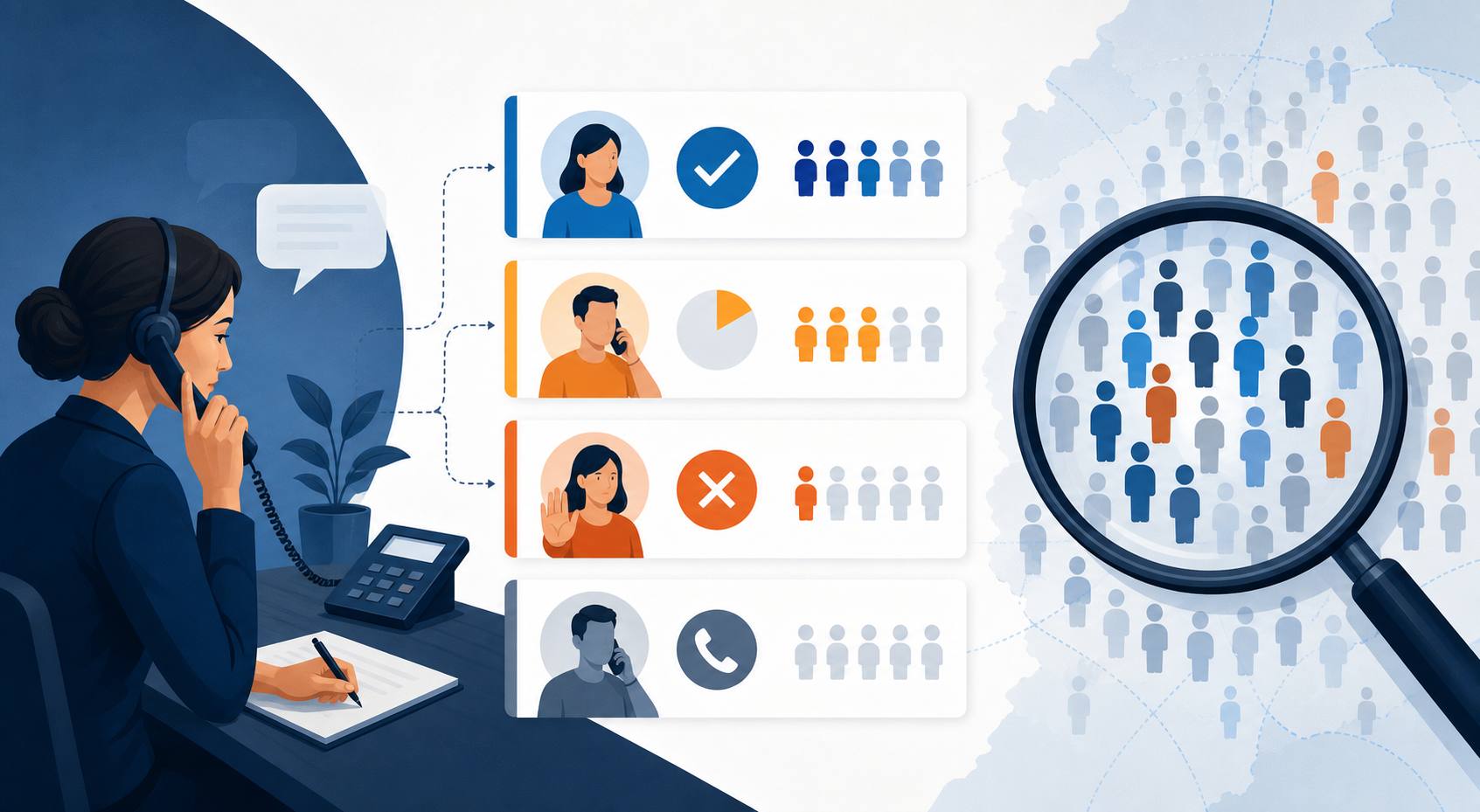
Research question and evidence scope
A questionnaire update can look minor in a document diff while changing what an answer means. Replacing “satisfied” with “very or somewhat satisfied,” moving a sensitive item later, adding an interviewer instruction, or changing a skip rule may alter response behavior and eligibility. This research does not ask whether the newer wording is better in the abstract. It asks what evidence a survey owner needs before combining telephone responses gathered under different versions, and which controls an outsourced calling team needs during the transition.
Methodology. Create a version register before fieldwork that assigns an immutable identifier to every released instrument, language variant, response list, prompt, skip rule, introduction, and interviewer instruction. Define the intended estimand and comparison groups in advance. During a controlled transition, randomly assign versions when ethically and operationally appropriate, or document the nonrandom release mechanism when it is not. The observation unit is one eligible sampled contact linked to release time, version, interviewer, attempt history, item path, final disposition, and any correction event.
Begin with a semantic change map, not line counts. For each altered item, classify changes to construct, reference period, subject, response scale, order, mode instruction, eligibility, routing, and requiredness. A punctuation edit may be immaterial; inserting “in the last 30 days” changes the reference period. Adding “including online support” changes scope. Reordering choices can change primacy or recency effects. Reviewers should explain why comparability is expected, uncertain, or rejected for each output, rather than assigning one status to the entire instrument.
Operating scenario and evidence
Field controls must prevent version blending. The calling interface should display one released version, log the identifier automatically, and stop an interviewer from copying a convenient question from an older guide. When a respondent resumes later, the protocol must say whether to continue, restart, or preserve a partial under the original version. If a routing defect is discovered, quarantine affected paths and retain the actual questions shown. Silently correcting the stored version after the call destroys the evidence needed to understand the responses.
Use paradata to locate transition effects without treating them as proof. Compare item nonresponse, breakoff position, clarification requests, changed answers, interview duration, routing anomalies, and interviewer comments across versions. Differences may reflect wording, but also sample composition, time of day, campaign events, caller assignment, or technical changes. A predeclared model can adjust for observed differences, yet unmeasured confounding remains. The report should describe alternative explanations and resist turning a correlation into a claim that one wording caused behavior.
Method and review criteria
Interviewer calibration should use paired practice cases. Callers administer each version exactly as released, including response options and neutral probes, while observers record deviations by item. Training must not ask callers to make the versions sound equivalent through improvised paraphrase; that masks the difference the study needs to evaluate. When respondents ask what changed, callers use owner-approved language and do not suggest the desired answer. Record coaching separately from production results so learning effects do not vanish into the trend.
The analysis should define three outputs. Version-specific results describe each instrument on its own terms. Bridged results use only items with a documented comparability rationale and show version as a variable. Non-comparable results remain separated or are retired. Publish sample counts, contact and cooperation dispositions, missingness, item paths, and uncertainty for each. A single pooled percentage is unacceptable when the denominator, question meaning, or response options changed, even if combining produces a more stable-looking number.
A bridge sample can strengthen the decision, but it has limits. If feasible, administer both forms to equivalent randomly assigned samples during an overlap window, keeping contact rules and interviewer allocation balanced. Do not give both versions of the same item to one respondent without studying order and carryover effects. Predefine the smallest operationally important difference and avoid claiming equivalence merely because a small sample found no statistically detectable gap. Lack of evidence for a difference is not proof of sameness.
Authority and practical implications
Privacy controls should cover both answers and the version history. Retain only fields needed to understand eligibility, routing, response, and quality; use pseudonymous identifiers in the analysis; separate contact details from response files; restrict exports; and define deletion and correction procedures. The Philippines Data Privacy Act and NIST Privacy Framework are relevant first-party sources for governance, while the AAPOR best-practices material informs survey design and disclosure. Their presence does not itself make a campaign compliant or methodologically valid.
Translation versions need more than a shared version number. Record the source instrument, translator and review process, release date, language and locale, and any item whose meaning could not be mapped directly. Back-translation or expert review can reveal differences, but neither guarantees equivalent respondent interpretation. Analyze language groups separately when evidence for pooling is weak. Callers should use the assigned language instrument and flag a requested language switch; they should not translate an item spontaneously during the interview and store it as if the approved wording was used.
Corrections must preserve the raw event. If an interviewer selects the wrong response and corrects it under protocol, retain the original entry, corrected value, reason, time, and permitted actor. If software routed a respondent past an item, mark the answer structurally missing rather than inventing a response. Post-field cleaning rules should be written before analysts see attractive results. An auditable correction trail lets the survey owner separate respondent answers, interviewer errors, platform defects, and analyst transformations.
Limitations, conclusion, and sources
The report should include an item-level comparability table. For every published measure, name the versions included, exact construct, denominator, response mapping, missingness rule, bridge evidence, and residual uncertainty. Also list measures excluded from trend reporting and explain why. This negative inventory is valuable: it stops future users from rediscovering an old column and pooling it without context. Archive the decision alongside the instrument so comparability judgments survive staff turnover and dashboard redesign.
Set a release gate for dashboards and downstream files. A new version should not enter a continuous trend until the survey owner records the comparability decision, approves mappings, and labels excluded items. Automated exports must carry the version identifier and should reject unknown mappings. This gate turns methodological review into an operational control and prevents an analyst from accidentally joining columns that share a name but no longer measure the same thing.
The outsourced caller’s boundary is precise administration. They may read the assigned introduction and items, use the released neutral probes, apply the displayed route, record a respondent correction, and flag a suspected defect. They should not choose versions based on respondent characteristics, repair confusing language from memory, skip an uncomfortable item outside protocol, infer a missing answer, or promise how results will be used. The survey owner controls the instrument, sample, analysis, disclosures, and every decision to combine data.
Limitations and non-claims. Random assignment may be unavailable, overlap samples can be underpowered, translation changes may interact with culture or interviewer delivery, and external events may coincide with release. Paradata cannot reveal every reason for a response. This research does not produce a benchmark for OutsourcedCallers.com or Filipino survey callers, establish causation automatically, or guarantee population inference. It offers a protocol for making version changes visible and for limiting conclusions to evidence the design supports.
Niche-specific conclusion. A buyer using a Philippines-based survey team should demand automatic version capture, immutable instruments, trained neutral delivery, defect escalation, and version-aware reporting before reviewing toplines. The essential question is not whether callers completed the new script. It is whether every answer can be traced to the wording, choices, route, sample conditions, and version that produced it. When that trace is incomplete, the honest output is separated results and explicit uncertainty, not a cosmetically continuous trend.
Sources: Best Practices for Survey Research | American Association for Public Opinion Research | https://aapor.org/standards-and-ethics/best-practices/ | checked 2026-10-05 || NIST Privacy Framework | National Institute of Standards and Technology | https://www.nist.gov/privacy-framework | checked 2026-10-05 || Republic Act No. 10173: Data Privacy Act of 2012 | National Privacy Commission of the Philippines | https://privacy.gov.ph/data-privacy-act/ | checked 2026-10-05 || Records Management Regulations, Policy, and Guidance | National Archives and Records Administration | https://www.archives.gov/records-mgmt/policy | checked 2026-10-05 || Unwanted Calls/Texts - Phone | Federal Communications Commission | https://consumercomplaints.fcc.gov/hc/en-us/articles/115002234203-Unwanted-Calls-Texts-Phone | checked 2026-10-05