
Philippines staffing research
How should an outsourced survey-calling team interpret refusal patterns without overstating the result?
A research design for preserving refusals, partial interviews, and contact conditions before a client interprets telephone responses as customer opinion.
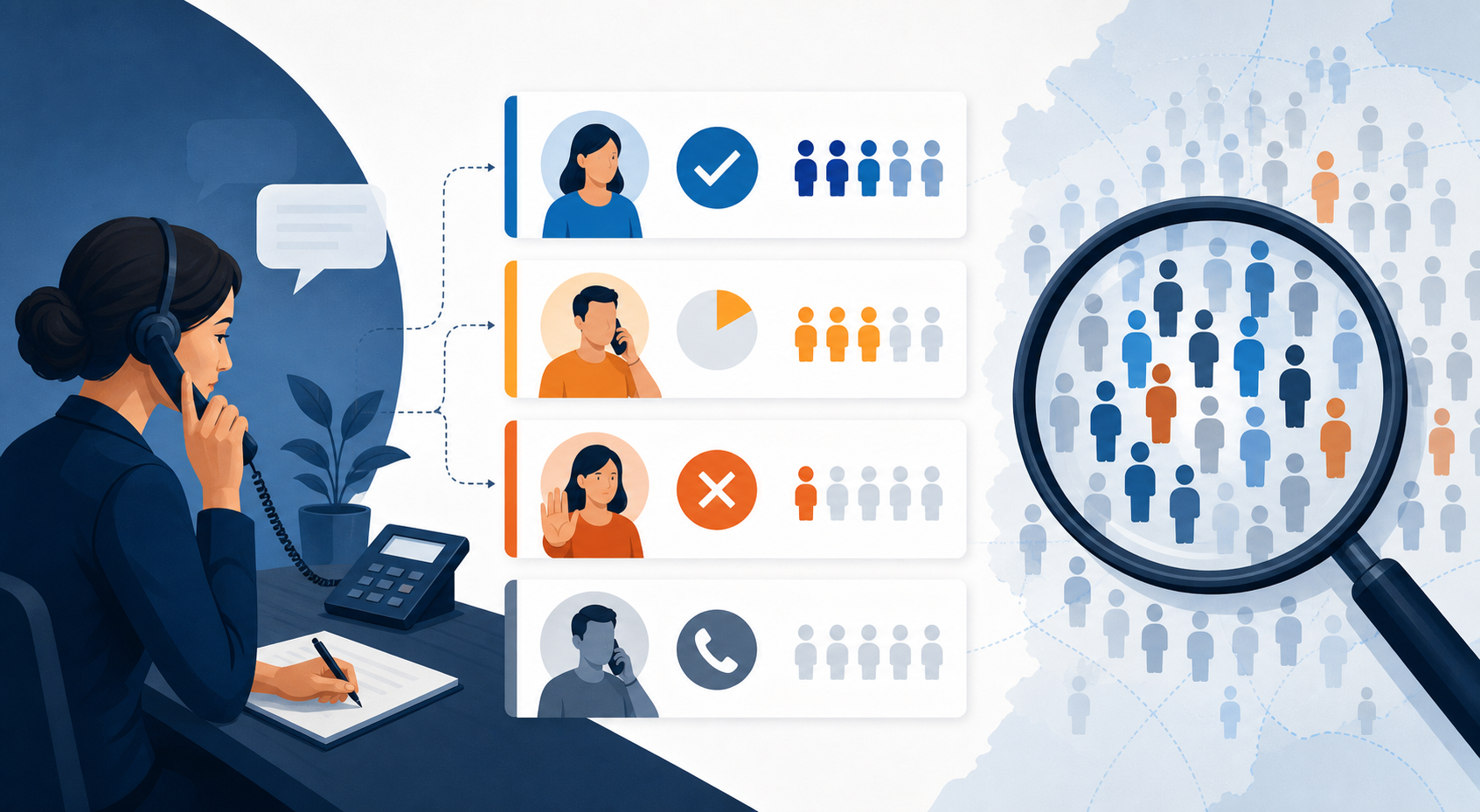
Published: August 20, 2026 (2026-08-20). Research question: what can refusal and partial-completion patterns tell a client about a telephone survey, and what can they not tell it about the wider population? A Filipino survey caller may faithfully ask every approved question while the sample still reflects who answered, who declined, when the call occurred, and how the frame was built. Research quality therefore depends on preserving nonresponse as evidence instead of hiding it inside a completion percentage.
Evidence scope and method: define the sample frame, release period, call attempts, contact states, refusal wording, partial interviews, language route, interviewer assignment, and final questionnaire status before collection. Use AAPOR, Pew, and Census materials to distinguish questionnaire practice, survey error, and population inference. These sources do not produce a benchmark for OutsourcedCallers.com or Filipino callers. The proposed method is to audit a fixed sample and report collection conditions alongside substantive answers.
A refusal establishes that a person did not provide the requested interview at that contact opportunity, subject to the quality of the record. It does not establish that the person disagrees with the survey subject, is uninterested in the product, or represents a silent group. A partial interview provides some answers and some missingness. A “don’t know” answer is different from a refusal. These distinctions must remain visible in the data and in the client’s interpretation.
The scenario is a client comparing strong opinions in completed calls with weak engagement in a later online form. A tempting explanation is that customers changed their minds. The evidence may instead reflect mode, sample composition, question order, call time, language, interviewer assignment, or who felt comfortable answering by phone. The calling team can preserve these conditions and administer the instrument consistently; the research owner decides what comparison the design can support.
The study should pre-register the disposition tree before the first call: eligible and complete, eligible and partial, eligible refusal, ineligible, wrong party, unreachable, language route needed, callback requested, and unknown. Keep the number of attempts and contact window. Preserve the exact neutral refusal or callback state when permitted. Do not reclassify a refusal as “not interested” unless the respondent actually said that and the instrument defines the code. The frame and denominator should be documented.
A credible measure reports completion, refusal, partial, and unreachable rates with their denominators and field period. It can also inspect whether patterns differ by interviewer, language route, time window, or frame segment, but small cells should not be overinterpreted. The measure is a description of the sample process, not an estimate of public opinion by itself. A high completion rate does not repair a biased frame, and a low rate does not prove the questionnaire was poor.
The role boundary protects neutrality. Do not argue with a refusal, imply that the person should participate, fill a missing answer from context, or reword a question toward the client’s preferred result. A Filipino caller can repeat the approved purpose, offer the permitted opt-out, use an approved neutral probe, and record the response state. The research owner controls weighting, exclusions, inference, and any claim about a target population.
Review should compare the instrument version, call behavior, disposition, and stored answer. Listen for leading probes, skipped eligibility questions, changed wording, unrecorded refusals, and pressure after a stop request. Compare a sample of completed interviews with the source frame and the final dataset. The goal is to protect respondent meaning and make missingness auditable. It is not to make the completion chart look more favorable.
The Philippines-specific implication is that survey callers should be assessed on protocol fidelity and respectful interaction, not on a presumed ability to make respondents agree. Training can cover neutral pacing, clarification that does not lead, exact use of response categories, and clean handling of language needs. A caller who records “refused” accurately has produced useful research evidence. Treating that record as a failure would encourage the wrong behavior.
Interpretation should begin with the question the sample can answer. If the question is how completed respondents answered, the completed-interview denominator may be appropriate for a descriptive table. If the question is how the released eligible cohort responded, refusals, partials, and unknowns cannot disappear. If the question concerns a wider customer population, the frame, selection process, coverage, weighting, and field conditions become part of the claim. These are different estimands. A calling team can support all three only by preserving the states that let the research owner choose honestly. A single “response rate” label cannot carry those distinctions on its own.
Before publishing a finding, the owner should inspect whether the refusal pattern is concentrated in a particular segment or contact condition. That inspection is not permission to invent a reason for nonresponse. It is a prompt to describe what is known: the frame segment, attempt count, field window, mode, interviewer or language route, and the disposition recorded. If a pattern is too small or the auxiliary information is incomplete, say so. Transparent uncertainty is part of the result. It keeps a survey-calling routine from becoming a hidden sales script and lets readers judge whether the observed answers support the decision being considered.
Limitations: refusal patterns are affected by population, frame quality, topic sensitivity, mode, contact technology, timing, incentives, interviewer behavior, and the wording of the instrument. A desk study cannot estimate nonresponse bias without design and auxiliary data. It also cannot infer a respondent’s reason for refusing unless the person states one. Any publication claim must be limited to the actual sample and method.
Sources: https://aapor.org/standards-and-ethics/best-practices/ | https://www.pewresearch.org/methods/u-s-survey-research/questionnaire-design/ | https://www.census.gov/programs-surveys.html | https://www.bls.gov/ooh/office-and-administrative-support/customer-service-representatives.htm
Conclusion: refusal patterns are part of the evidence scope, not noise to discard. An outsourced survey-calling team supports credible interpretation by preserving every disposition, administering the approved instrument neutrally, and making the collection conditions visible. The research owner must decide what the resulting sample can legitimately say.